Best Open-Source CDPs & Self-Hosted Segment Alternatives (2026)
An honest ranking of open-source and self-hosted CDPs — PostHog, Jitsu, RudderStack, Apache Unomi, Tracardi, and Snowplow — scored on license, warehouse fit, integrations, and ops burden. Jitsu is not ranked first.

An open-source CDP collects customer events from your sites, apps, servers, and tools, then makes that data usable in your warehouse, analytics stack, or activation tools. Teams usually look for a self-hosted CDP when Segment-style SaaS pricing starts to hurt, when compliance requires tighter control, or when they want raw event ownership instead of a vendor-shaped data model.
Jitsu publishes this guide, so here is the disclosure: Jitsu is in the comparison, and it is not ranked first by default. The ranking below uses the same criteria for every product: license, self-hostability, warehouse fit, integration coverage, developer experience, maintenance, real-time support, and best-fit use case.
The main takeaway: there is no single best open-source CDP. PostHog has the strongest open-source product/community footprint. Jitsu is the cleaner fit if you want a lean, warehouse-first event pipeline. RudderStack has the broadest integration catalog, but current rudder-server licensing is Elastic License 2.0 rather than OSI open source. Snowplow is mature, but new Community Edition production use is restricted by SLULA, so do not call it open source for production deployments.
How we ranked these
We ranked each tool on eight criteria:
- License type: OSI open source, source-available, fair-code, or proprietary.
- Self-hostability: whether you can run it yourself, and whether production use is allowed.
- Warehouse-native architecture: how naturally the tool sends data to Snowflake, BigQuery, Redshift, Postgres, ClickHouse, or similar stores.
- Integration breadth: sources, destinations, SDKs, and connector ecosystem.
- Developer experience: setup path, docs, deployment effort, and maintenance burden.
- Community and maintenance health: GitHub activity, stars, release signal, and project maturity.
- Real-time vs batch: whether the product is built for live event delivery, scheduled syncs, or both.
- Best-fit use case: where the product wins without pretending it wins everywhere.
At-a-glance comparison
| Rank | Tool | License status | Self-host? | GitHub stars | Warehouse fit | Integrations | Best fit |
|---|---|---|---|---|---|---|---|
| 1 | PostHog | MIT for core; ee/ separately licensed | Yes, Docker Compose; PostHog says Cloud is best for most users | ~37.7k | Good for analytics, warehouse, batch exports, and realtime destinations | Broad product suite rather than a pure CDP catalog | Product teams that want analytics, replay, flags, experiments, and CDP-like pipelines in one stack |
| 2 | Jitsu | MIT | Yes; open source self-host has no usage limits | ~5.0k | Strong warehouse-first event pipeline | Smaller catalog than RudderStack; unlimited destinations in Jitsu pricing | Data teams that want a lean real-time Segment alternative into their warehouse |
| 3 | RudderStack | Elastic License 2.0 for rudder-server; source-available, not OSI open source | Yes in practice, but license terms matter | ~4.5k | Strong warehouse and reverse ETL orientation | 16+ SDK sources, 15+ cloud event sources, 200+ cloud destinations, 10+ warehouse/data lake destinations | Teams that value integration breadth and can accept source-available licensing |
| 4 | Apache Unomi | Apache 2.0 | Yes | ~372 | Profile-store/CDP foundation more than event-pipeline SaaS replacement | REST API, plugins, Groovy actions, OSGi plugins | Enterprises or agencies that want an Apache-licensed profile store and can handle Java/Karaf/Elasticsearch |
| 5 | Tracardi | MIT with Commons Clause; fair-code/source-available, not OSI open source | Yes; Docker-oriented; commercial tiers for scale/SaaS | ~653 | More customer-profile/orchestration centric than warehouse-native | 31 documented extensions | Smaller teams that want low-code CDP workflows and can accept license restrictions |
| 6 | Snowplow | Mixed; new pipeline components under SLULA/source-available terms | Community Edition self-host is for testing/evaluation, not production | ~7.0k | Very strong behavioral data pipeline | SDKs, enrichments, warehouse/database/lake/stream outputs | Mature behavioral data infrastructure if you are willing to buy the commercial production license |
PostHog: best open-source product suite, not a pure CDP
PostHog earns the top spot if you define the job broadly: collect product events, analyze behavior, replay sessions, run feature flags, run experiments, and send data onward. The core repository is MIT-licensed outside separately licensed enterprise areas, and PostHog’s self-hosting docs say the product is open-source and freely available to host yourself under an MIT-licensed Docker Compose deployment.
Where PostHog wins: community size, product breadth, and buyer clarity. The repository has roughly 37.7k GitHub stars, which is much larger than the other tools in this list. PostHog Cloud pricing also has a concrete free tier, including the first 1 million product analytics events per month, 5k session replay recordings, 1 million requests, 1 million managed warehouse rows, 1 million batch export rows, 10k realtime destination trigger events, and other product-specific allowances.
Where it falls short: PostHog is analytics-first. If you want a small, dedicated real-time event router into your warehouse, PostHog may be more platform than you need. Self-hosting is real, but PostHog is direct about the operational burden: you manage infrastructure, deployments, scaling, backups, and risk, and PostHog says Cloud is the best experience for most users.
Best for: product-led engineering teams that want analytics plus adjacent CDP/data-pipeline capabilities in one open-source stack.
Jitsu: best lean warehouse-first Segment alternative
Jitsu is the strongest fit if the job is “collect events and stream them into our warehouse with minimal product sprawl.” Jitsu describes itself as 100% open source under the MIT license and self-hostable. Its site positions the product around sending web, app, email, chatbot, and CRM event data into your warehouse, with named warehouse support for Snowflake, BigQuery, Redshift, Postgres, MySQL, and ClickHouse.
Where Jitsu wins: it is simple, warehouse-first, and permissively licensed. Jitsu’s pricing page says the open-source version is “Free. Forever,” MIT licensed, self-hostable on any cloud provider, cloud native, and has no usage limits. Jitsu also has a straightforward cloud plan: the free cloud plan includes 200k active events per month, and Business is listed at $99/month with 2 million active events per month plus $40 per additional 1 million active events.
Where it falls short: Jitsu does not have RudderStack’s integration catalog or PostHog’s all-in-one product suite. If your decision hinges on hundreds of packaged destinations, identity resolution workflows, or built-in analytics UI, you will need to verify whether Jitsu’s connectors and functions cover your exact paths.
Best for: data teams that want a real-time, self-hostable, warehouse-native event pipeline and prefer MIT licensing over larger but more restrictive ecosystems. If you are coming from Segment, the Segment compatibility guide covers the fastest migration path.
RudderStack: broadest integration ecosystem, but not OSI open source
RudderStack is still one of the most credible Segment alternatives, especially if you care about integrations. Its pricing page lists 16+ SDK sources, 15+ cloud event sources, 200+ cloud destinations, 10+ warehouse and data lake destinations, 8+ warehouse and data lake sources, and Reverse ETL. For many buyers, that ecosystem is the main reason to consider it.
The honest license note matters. The current rudder-server repository reports “Other” on GitHub, and the raw license file is Elastic License 2.0. ELv2 is source-available and permits many internal uses, but it is not an OSI-approved open-source license. Older posts may still describe RudderStack’s server as AGPL or open source; verify against the current repository before publishing that claim.
Where RudderStack wins: integration breadth, warehouse sync, and enterprise-grade data activation paths. The pricing page also lays out warehouse sync intervals by plan, with 3-hour syncs on Free, 30-minute syncs on Growth, and 5-minute syncs on Enterprise.
Where it falls short: license clarity. If your requirement is truly OSI open source, RudderStack should not be counted the same way as MIT or Apache projects. It may still be the right choice, but the reason would be ecosystem coverage, not open-source purity.
Best for: teams that need a large integration catalog and are comfortable with source-available licensing.
Apache Unomi: most “true OSS” profile store, heavier developer experience
Apache Unomi is the cleanest answer if your buyer criteria start with “Apache project, Apache 2.0 license, open standards.” The project describes itself as an open-source Customer Data Platform with unified profiles, segmentation, privacy controls, real-time profile updates, a REST API, plugin architecture, Groovy actions, and OSGi plugin support. Its site lists v3.0.0 as the latest release.
Where Unomi wins: governance, license, and extensibility. Apache 2.0 is permissive and OSI-approved. The architecture is useful if you want a first-party customer profile service, privacy controls, segmentation, and custom integrations rather than a SaaS-style event-routing product.
Where it falls short: developer experience and ecosystem shape. Unomi is Java/Karaf/Elasticsearch-based, and its GitHub footprint is much smaller than PostHog, Snowplow, Jitsu, or RudderStack. It is probably not the fastest path if your only goal is to replace Segment’s JavaScript snippet and warehouse destinations.
Best for: organizations that want an Apache-licensed CDP foundation, have Java/platform engineering capacity, and care more about profile infrastructure than a polished cloud-style connector catalog.
Tracardi: useful low-code CDP, but Commons Clause changes the open-source story
Tracardi is a low-code/no-code CDP focused on customer profiles, event orchestration, and automation. Its GitHub README says it is available under “MIT with Common Clause,” and the license docs say the Commons Clause removes the right to sell the software, including paid hosting, consulting, or support services whose value derives substantially from the software.
That makes Tracardi fair-code or source-available, not OSI open source. This may be fine for internal use, but it is not the same buyer profile as MIT or Apache 2.0. The pricing page also makes the split clear: the Open-Source Version is aimed at small companies and includes behavioral data collection, profile stitching, event/profile orchestration, and simple automation. Commercial Enterprise adds event validation, custom profile merging, parallel processing, extended automation, programmable data streams, queue collection, test/production separation, and customer activation.
Where Tracardi wins: speed to low-code workflows. Its docs list 31 extensions, including ActiveCampaign, Airtable, Amplitude, HubSpot, Mailchimp, Matomo, Mautic, Mixpanel, PostgreSQL, RabbitMQ, Salesforce, SendGrid, and Zapier.
Where it falls short: scale and license. The pricing page says the open-source version has limited collected events per second, single-tenant installation, limited automation, and no event validation.
Best for: smaller teams that want self-hosted customer-profile workflows and can live with fair-code restrictions.
Snowplow: mature behavioral data infrastructure, but not production-open-source anymore
Snowplow is mature and technically strong. It has roughly 7k GitHub stars, a long history in behavioral data infrastructure, and self-hosted docs that describe web, mobile, and server-side SDKs, custom events and entities, enrichments, and outputs to a warehouse, database, lake, or real-time stream.
The license status is the reason it ranks last in an open-source guide. Snowplow’s Limited Use License FAQ says SLULA 1.0 rolled out in January 2024 and 1.1 in December 2024. The self-hosted Community Edition docs say it is meant for testing and evaluating Snowplow and must not be deployed in production. The FAQ says commercial or production environments require a commercial license.
Where Snowplow wins: event modeling, pipeline maturity, and data quality. If your team has data engineering capacity and budget, Snowplow can be a serious customer data infrastructure choice.
Where it falls short: you should not evaluate current Community Edition as a free production open-source Segment alternative. It is source-available for limited use, and production use requires a commercial path.
Best for: teams that want mature behavioral data infrastructure and are prepared for commercial licensing.
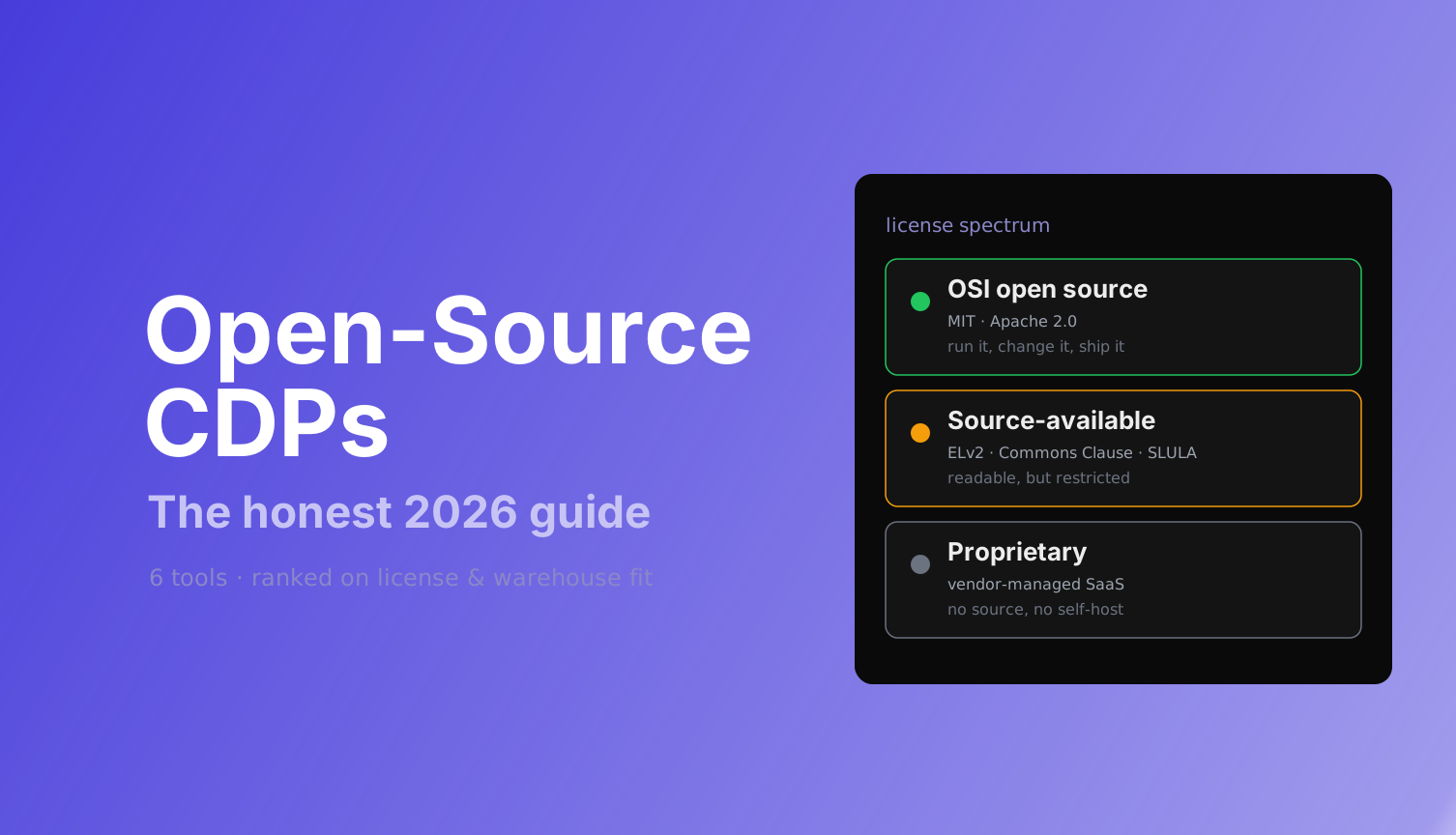
Open source vs source-available vs proprietary
The license distinction is not pedantic. It changes cost, control, and exit options.
OSI open source means the license meets the Open Source Definition. MIT and Apache 2.0 are the clean examples in this guide. You can usually use, modify, host, and redistribute the software with minimal restrictions, subject to the license terms.
Source-available means you can read the code, and sometimes run it internally, but the license restricts important uses. ELv2, Commons Clause, and SLULA-style licenses can be reasonable commercial choices, but they are not the same as MIT or Apache 2.0.
Proprietary means the vendor controls the software and usually sells access as SaaS or a commercial license. Segment, Hightouch, Census, Tealium, and mParticle are still worth knowing, especially for enterprise buying cycles, but they do not solve the same problem as a self-hosted open-source CDP.
How to choose
If you want a real-time event pipeline into your warehouse, start with Jitsu. It has the cleanest fit for teams that want Segment-style collection without per-event SaaS dependency, and the MIT license keeps the self-hosted path simple.
If you want product analytics plus data pipelines, start with PostHog. It is less pure as a CDP, but the product breadth and community are hard to ignore.
If you need the widest connector catalog, evaluate RudderStack. Just do it with eyes open on the current ELv2 license.
If you need an Apache-licensed customer profile service, evaluate Apache Unomi. It is the best fit for custom CDP infrastructure, not the easiest plug-and-play event router.
If you want low-code customer journeys and automation, evaluate Tracardi. It can be useful internally, but Commons Clause and open-source tier limits matter.
If you want high-maturity behavioral data infrastructure, evaluate Snowplow’s commercial path. Do not treat Community Edition as a free production open-source option.
Proprietary alternatives worth knowing
Segment remains the default reference point for managed CDP/event collection. Hightouch and Census are more warehouse-activation and Reverse ETL oriented. Tealium and mParticle are enterprise CDP platforms with broader governance and identity features. These tools can be the right choice when you want a vendor-managed system, procurement support, and enterprise controls, but they are not replacements for source code ownership or a self-hosted deployment.
FAQ
Is there a free open-source alternative to Segment?
Yes. Jitsu is MIT-licensed and self-hostable, and PostHog’s core is MIT-licensed outside separately licensed enterprise areas. Apache Unomi is Apache 2.0. Your best choice depends on whether you need event routing, product analytics, or customer profiles.
Is Snowplow still open source?
Not for new Community Edition production use in the way many buyers mean “open source.” Snowplow’s docs say SLULA applies to Community Edition, that Community Edition is for testing/evaluation, and that production or commercial use requires a commercial license.
Can I self-host a CDP?
Yes, but “can self-host” is not the same as “easy to run in production.” Jitsu, PostHog, Apache Unomi, Tracardi, RudderStack, and Snowplow all have self-hosting stories, but the license terms and operational burden differ sharply.
What is the cheapest CDP?
For software license cost, MIT/Apache self-hosted tools are the cheapest because the license fee can be zero. For total cost, include infrastructure, upgrades, monitoring, on-call work, and engineering time. A managed cloud plan can be cheaper than self-hosting if your team is small.
Which open-source CDP is best for data warehouses?
Jitsu is the cleanest warehouse-first choice in this list because its core positioning is real-time event collection into warehouses such as Snowflake, BigQuery, Redshift, Postgres, MySQL, and ClickHouse. RudderStack also has strong warehouse and reverse ETL coverage, but the current server license is source-available rather than OSI open source.
Which CDP has the largest open-source community?
PostHog has the largest GitHub footprint in this comparison, with roughly 37.7k stars as of this draft. Stars are not product fit, but they are a useful signal for community attention and project momentum.
Closing take
If you need an honest shortlist, start with three questions. Do you need an OSI-approved license? Do you need a pure event pipeline or a broader product analytics suite? Do you want to run production infrastructure yourself?
For permissive self-hosted event collection, Jitsu is the most direct Segment alternative. For product analytics breadth, PostHog is hard to beat. For connector coverage, RudderStack deserves evaluation, but not under the label “open source” unless its license changes. For strict Apache governance, Unomi is the cleanest. For behavioral data infrastructure, Snowplow is serious, but commercial.
Related comparisons
- All Jitsu comparisons — the full comparison directory, including where each competitor wins.
- Jitsu vs Segment — open-source CDP or managed pipeline.
- Jitsu vs RudderStack — fully open vs open-core.
- Jitsu vs Snowplow — truly open source vs source-available.
- Self-hosted vs managed CDP — how to choose, without a predetermined answer.
Stream your events into your warehouse with Jitsu
<script
 async
 src="https://data.yourcompany.com/p.js">
</script>--get signup page views in the last day
select * from events where
context_page_path = '/signup' and
timestamp > now() - interval '1 day'